
Duty validation
Demanding duty, used to prove lasting durability.
- Test duty
- Poultry-house vacuum
- Pressure points
- 0 / 50 / 75 / 100 Pa
- Sample
- 2.2 kW · 750 rpm
- Fan
- 58 in
Demanding duty, used to prove lasting durability.
Rasta uses livestock negative-pressure fans as a durability-validation duty, recreating poultry-house negative pressure in a sealed test space and observing operation as pressure rises and cooling airflow falls.
Why this duty: as negative pressure rises, motor power climbs while the airflow available to cool it falls away. The two curves move in opposite directions, testing insulation and structural integrity at once.
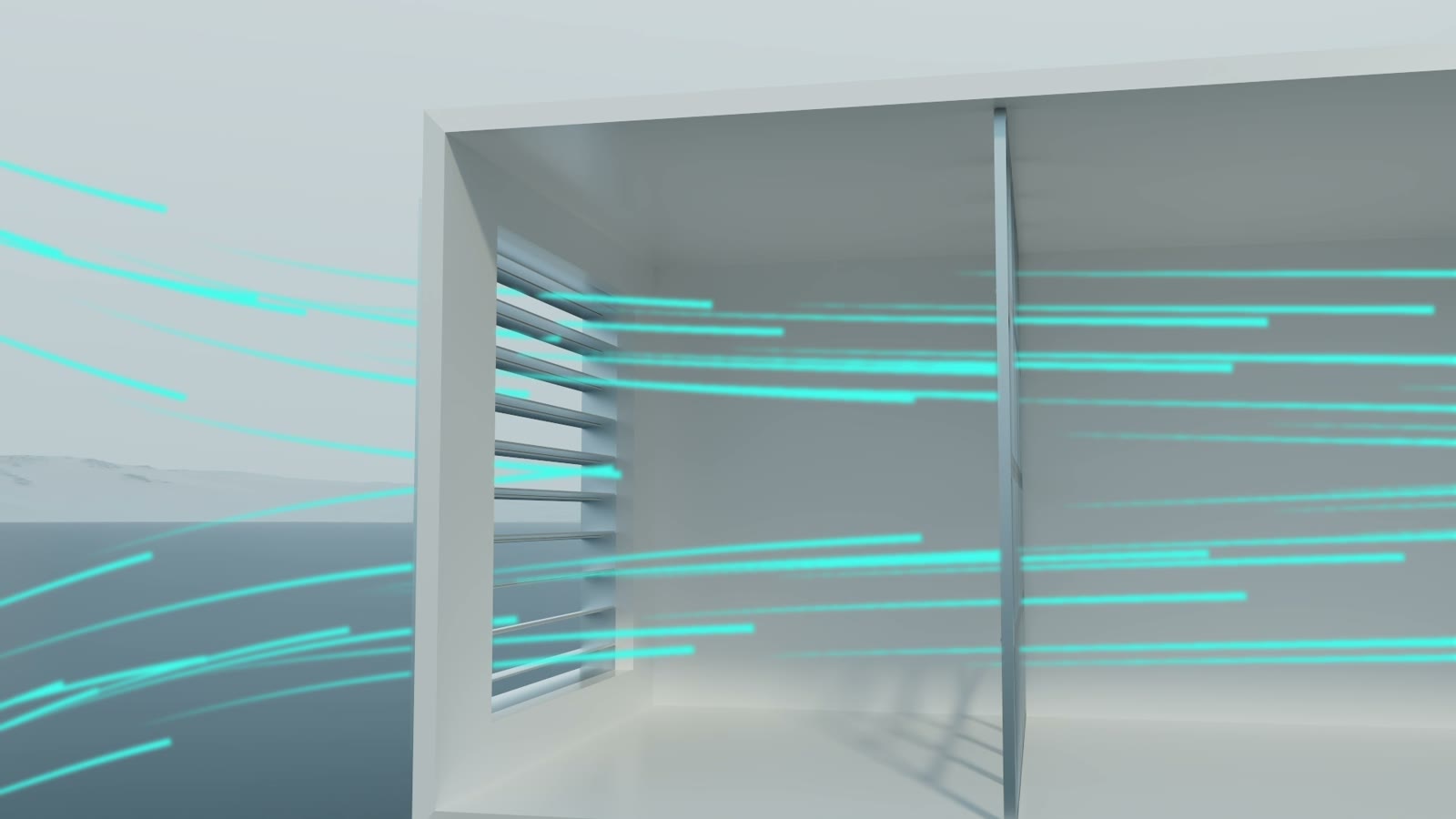
Validation under negative-pressure duty
- 01
Recreate the negative pressure
The poultry-house negative-pressure environment is recreated in a sealed chamber. The fan starts at full speed and negative pressure builds instantly.
- 02
Power rises, cooling falls
Motor power climbs with the negative pressure while cooling airflow drops sharply — the two curves move in opposite directions, and that is what makes this duty hard.
- 03
Test insulation and structure
This is the ultimate test of insulation performance and structural integrity. The data becomes the basis for product iteration, not merely a report.
Footage exists: AE clips sc_1 (exterior push-in, 4 s) and sc_5 (closing shot, 5 s). Needs re-cutting from un-subtitled sources, compression, and a still poster.
Footage exists: sc_3 (20 s, multi-camera), sc_2 and sc_2_2 (chamber cutaway and airflow lines). Note that sc_4 is an illustrative thermal animation — if used it must be labelled as such and never presented as measured temperature rise.
Test records at four static-pressure points
This is the only set of factory-measured data on the site. The four points are drawn at face value, unsmoothed and not extrapolated.
Unit correction
The source labels the power column kW. Airflow divided by power gives about 41.41 / 25.61 / 19.56 / 15.33, close in magnitude to the tabulated 41.17 / 25.56 / 19.37 / 15.24. This supports W as the likely unit but is not an exact match; the original unit and calculation basis require written factory confirmation before publication.
What this table still lacks
- DInstrument and range
- DConditions: ambient temperature, humidity, pressure
- DReport date and sample number
- DDistinction between input power and rated output
- DAirflow measurement method and efficiency basis
Until these are supplied the table is labelled "factory data, conditions pending"; no public energy-saving curve is generated from it, and it supports no comparative claim.
EC80 insulation and temperature data
The EC80 legacy English FAQ gives an insulation class, a material temperature value and one measured value, but not the conditions or definitions. The values are retained without carrying them across series or turning an under-specified subtraction into a performance claim.
Insulation class
F
Winding limit
155 ℃
Measured, 2.2 kW
98 ℃
CNo margin calculated
155 °C may be the value associated with the material thermal class, while 98 °C is the legacy site’s stated highest measurement. Without ambient, load point, measurement location and acceptance basis, they are not like-for-like and do not establish a temperature-rise margin.
These values come from the standalone English FAQ and are treated as conditional, grade C information. The test conditions must be obtained with the original axial-fan report before any publishable conclusion is drawn.
Test footage and its permitted use
- AReal chamber footagesc_1 / sc_2 / sc_2_2 / sc_3 / sc_5, 1920×1080 / 50fps
- CThermal animation sc_4Illustrative only; must be labelled and cannot stand as a measured thermal report
- DUn-subtitled, un-letterboxed sourcesThe existing film carries subtitles and letterboxing and cannot be looped directly
- DOverseas landmarks and industry scenesAppearing in the film does not make them the customer's own plant or project
The films are 3840×2160 / 50fps, 5 min 02 s in Chinese and 5 min 22 s in English. They are a good source library but not a web-ready asset — a hero needs a 6–10 second silent loop cut from the original sources, with its own phone crop and still poster.
The full film keeps a click-to-play entry on the company page and never autoplays.